


Most pool accidents don’t happen because people are reckless. They happen because it’s a normal day… someone thinks “just two minutes”… and that’s all it takes for things to go wrong.
So if you’re reading this because you want a safer pool—at home, at a lodge, at a school, at a gym, or in an estate—you’re already doing the right thing.
Pool safety isn’t about turning your pool into a military zone. It’s about putting a few smart layers in place so one small moment doesn’t become a life-changing event.
The good news? Most of the biggest risks are preventable with simple habits and a bit of setup.
Make Your Pool Safer — Get a Site Check
Tell us where you’re based and what type of pool you have. We’ll recommend practical safety upgrades and a maintenance plan that keeps things secure.
Start with the one rule that matters most: active supervision
Let’s be real: signs and rules help, but supervision is the biggest “safety system” you can have.
Drowning risk increases when children are around water without active adult supervision.
And “supervision” doesn’t mean sitting nearby on your phone. It means an adult is actually watching—ready to react if someone slips, panics, or gets tired.
If you have kids around the pool, the safest mindset is: close enough to reach, eyes on the water, no distractions. (Even confident swimmers can get into trouble quickly.)
Add a physical barrier: the pool shouldn’t be “easy to wander into”
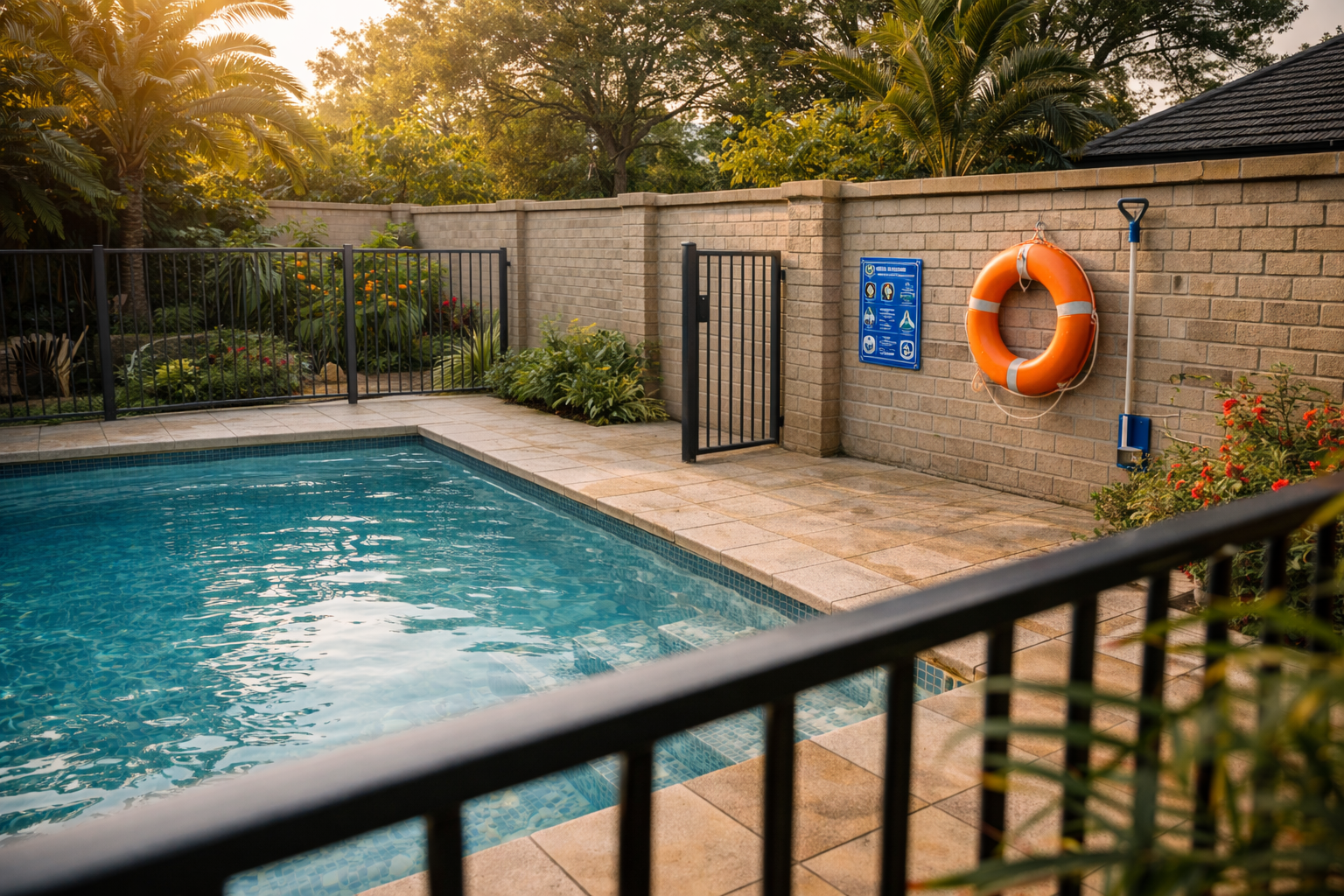
If you only invest in one physical safety upgrade, make it a proper pool barrier.
The CDC specifically recommends a four-sided fence that fully encloses the pool and separates it from the house, with self-closing and self-latching gates.
That “four-sided” part matters, because it’s what stops a child from stepping straight from a door into the pool area.
Also—small detail, big impact—keep toys out of the pool area when the pool isn’t being used. Kids are drawn to toys, and that’s often how unsupervised access happens.
Make the pool area safer to move around
A lot of injuries aren’t “in the water.” They happen on the way in.
So think in simple, practical terms:
-
keep the deck clear (no hoses, loose tiles, clutter)
-
discourage running (wet surfaces and speed don’t mix)
-
fix slippery problem areas quickly
-
keep steps and edges clean so they don’t get slick
If you manage a lodge or guesthouse pool, this matters even more because people assume the space is “ready” and don’t walk cautiously.
Make Your Pool Safer — Get a Site Check
Tell us where you’re based and what type of pool you have. We’ll recommend practical safety upgrades and a maintenance plan that keeps things secure.
Use clear pool rules that don’t feel like a lecture
Rules work best when they’re short and obvious. You don’t need a long list—people won’t read it.
The basics that prevent the most problems:
-
no swimming alone (especially kids)
-
no diving unless it’s clearly a deep, designated area
-
no rough play that pushes people under
-
no glass near the pool
For public/commercial pools, “no diving” and depth awareness signage is a standard safety approach in pool codes and guidance.
Don’t ignore drain safety (it’s rare, but it’s real)
Most pool owners never think about drains… until a cover is missing or broken.
At a practical level:
-
regularly check that drain covers are intact and secure
-
don’t allow kids to play around drains
-
keep long hair tied back if someone likes to hover underwater near outlets
-
if you notice a broken/missing cover, treat it as urgent
Public pool safety guidance includes requirements around safety equipment and signage, including expectations for safe facility operation.
Keep water healthy, not just “blue”
Clear water doesn’t automatically mean safe water. A pool can look fine and still irritate eyes, trigger rashes, or spread germs.
The safest approach is:
-
keep routine water checks consistent
-
don’t let problems “drift” for weeks
-
encourage basic hygiene (especially for busy pools)
CDC healthy swimming guidance also stresses preventing drowning (supervision, barriers) and encourages water safety skills and CPR readiness as part of pool safety.
Make Your Pool Safer — Get a Site Check
Tell us where you’re based and what type of pool you have. We’ll recommend practical safety upgrades and a maintenance plan that keeps things secure.
Have an emergency plan before you need it
Nobody wants to imagine an emergency at their pool. But the whole point of safety is being ready before something happens.
At minimum:
-
keep a simple first-aid kit nearby
-
keep a phone within reach (not locked inside the house)
-
make sure the pool address/location is clear for guests/staff
-
if it’s a commercial pool, make sure staff know who calls for help and what the process is
Learning CPR is one of the most practical “skills-based” safety layers recommended in mainstream pool safety guidance.
(Important note: CPR should be learned properly through a recognised course—don’t rely on random shortcuts.)
If you manage a lodge, school, gym, or complex pool
Commercial pools are different, because you’re dealing with:
-
higher bather loads
-
unfamiliar swimmers (guests, learners, visitors)
-
reputational risk when something goes wrong
This is where you want safety to be “built into operations,” not just a poster on a wall. Pool codes and inspection guidance often focus on required safety equipment, signage, and operational practices, especially where no lifeguards are present.
Even if you’re not following every international standard word-for-word, the principle is the same: clear rules, visible signage, safety equipment on site, staff who know what to do, and a maintenance rhythm that keeps the environment stable.
Final thought
A “secure swimming environment” is really just layers:
supervision + barriers + sensible rules + safe surfaces + healthy water + emergency readiness.
You don’t need perfection. You need consistency.
If you’d like help making your pool safer (or maintaining it properly so it stays safe), Premium Pools can assist across Zimbabwe, including Harare, Bulawayo, Mutare, and other major towns.
Make Your Pool Safer — Get a Site Check
Tell us where you’re based and what type of pool you have. We’ll recommend practical safety upgrades and a maintenance plan that keeps things secure.


Comments are closed