


If you’ve never built a pool before, it’s easy to assume it’s basically: dig a hole, pour some concrete, fill it up, done.
Then you start getting quotes… someone mentions approvals… someone talks about “set-out”… someone asks where the pump room will go… and suddenly it feels like you’ve walked into a whole new world.
So let’s make it simple.
This is the swimming pool construction process in Zimbabwe—what actually happens, in the order it usually happens, and what you should expect along the way.
Whether you’re building at a home, a lodge, a school, a gym, or an estate, the fundamentals are the same. The difference is how the pool is designed, how it’s finished, and how much it needs to handle day-to-day.
The quick version (so you understand the flow in 60 seconds)
Here’s the “big picture” before we go step-by-step:
-
You choose the pool type and design (shape, depth, finishes, features)
-
The builder assesses the site (levels, access, soil, pump room location)
-
Plans/approvals are handled where required
-
The pool is set out and excavated
-
The structure/shell is built (concrete, gunite, or fibreglass shell install)
-
Plumbing and electrical conduits are installed
-
The pool is finished (coping, tiling/plaster, decking/paving as needed)
-
Equipment is installed and commissioned (filtration, pump, optional heating)
-
The pool is filled, balanced, tested, and handed over with a care plan
That’s the journey. Now let’s slow it down and explain each part like a normal conversation.
Get a Quote for Swimming Pool Construction
Not sure whether concrete, gunite, or fibreglass makes sense for your property? Send your details and we’ll guide you through the options.
Step 1: Choosing the right pool type for your property
Most people start with “I want a pool,” but the smarter starting point is: what kind of pool makes sense here?
In Zimbabwe, the common options you’ll hear about are:
Concrete / Gunite pools
These are popular when you want design flexibility (custom shapes, deeper sections, built-in benches, tanning ledges, unusual layouts). They’re also a strong choice when you’re building something that needs to look premium or handle heavier use—like hospitality or commercial properties. Premium Pools leans heavily into concrete and gunite for long-term durability and custom builds.
Fibreglass pools
Fibreglass can be a great fit if you want a faster install and a smooth, low-maintenance surface. The main constraint is that shapes/sizes are usually more “standard” compared to fully custom concrete/gunite builds.
A good pool builder will talk you through this in plain terms, based on your space, budget, timeline, and how the pool will be used—not just what they prefer to sell.
Step 2: Site assessment (the part that protects you from surprises)
Before anything is dug, a proper builder will look at the property and ask questions like:
-
Where will the pool sit best for sunlight and privacy?
-
How will machinery access the area for excavation?
-
Where should the pump/filter equipment go?
-
Are there drainage or slope issues that need planning?
-
What’s the safest, most practical route for plumbing lines?
This is also where you avoid the classic mistake: putting the pool where it “looks nice on paper” but becomes a headache to build (or maintain) because access is tight or levels are tricky.
Step 3: Approvals and permits (what you should know upfront)
This part varies by city and council, but here’s the practical takeaway:
If you’re doing structural construction on a property, there are cases where plans and approvals may be required, especially in urban areas or controlled developments. In Harare, for example, the City has a dedicated Construction Permits section with plan approval / permit documentation.
Bulawayo also has a formal process for plan approvals and building inspections, which signals that plan compliance is taken seriously.
Now here’s the “real life” version: most clients don’t want to run around offices figuring this out. A professional pool construction company should be able to guide you and help you handle this step as part of the project planning. Premium Pools explicitly positions itself as managing the stages from design and permits through to excavation and finishing.
Step 4: Set-out and excavation (where your pool becomes real)
This is where the team marks the exact pool position and levels on site and confirms measurements before excavation starts.
Then excavation begins.
This stage can feel fast because you finally see the hole forming… but it’s also one of the most important stages to do properly, because everything after this depends on the shape, levels, and stability of what’s been dug.
A clean excavation also helps the next teams work efficiently—steel fixing, plumbing routes, and the shell structure all rely on this foundation.
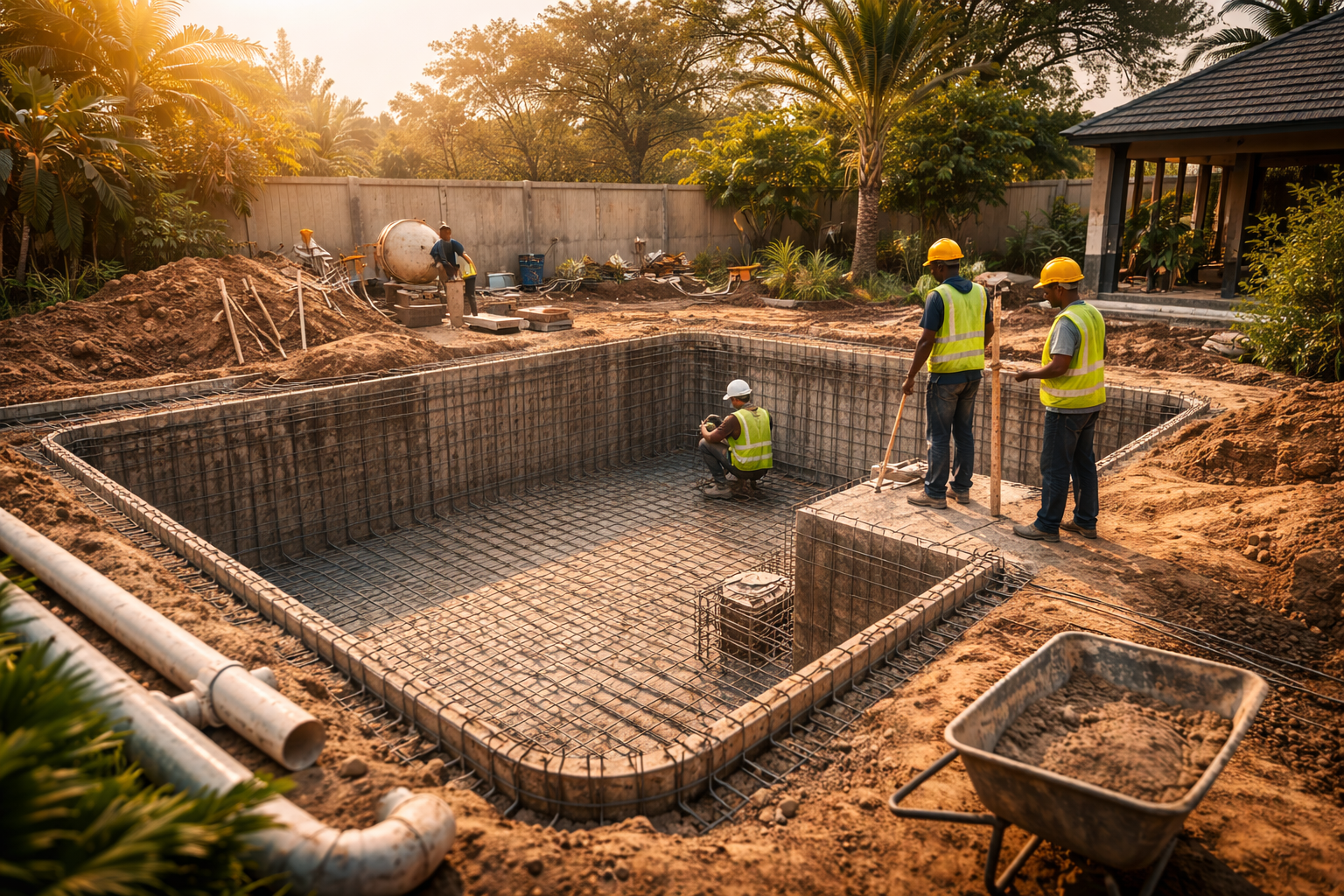
Step 5: Building the shell (the “bones” of the pool)
This is the structural part, and it’s where concrete/gunite and fibreglass installations differ.
For concrete/gunite pools, you’ll generally see:
-
steel reinforcement and formwork shaping the pool
-
the shell being built in a way that matches the final design
-
allowance for steps, benches, and any integrated features
For fibreglass pools, the “shell” is typically installed as a formed unit, positioned carefully, then connected and finished with plumbing, backfilling, and surrounds.
Either way, this is not the stage you want rushed. The shell is the part you live with for years.
Step 6: Plumbing and electrical planning (the stage homeowners forget to ask about)
This stage doesn’t look exciting—pipes, fittings, routes, and equipment planning—but it’s the difference between a pool that runs smoothly and a pool that keeps giving you issues.
Good planning here includes:
-
where water will circulate from and return to
-
how filtration will be set up
-
where isolation points and service access will be
-
how lighting (if included) will be routed safely
You don’t need to know the technical details as the client. You just need confidence that your pool builder is thinking ahead and building a system that’s easy to service.
Step 7: Finishing (where the pool starts looking “premium”)
Finishing is where your pool stops looking like a construction site and starts looking like something you’d actually want to swim in.
This typically includes:
-
the internal finish (the surface you see and feel)
-
coping and edging details
-
the surrounds: paving, decking, or landscaping tie-ins
-
any extra features you’ve chosen (like heating prep, cover fittings, etc.)
This is also where workmanship matters a lot—because finishes are visible. A pool can be structurally fine but look cheap if finishing is rushed.
If you’re going for a higher-end look, this is where details like neat lines, good drainage planning, and clean joinery make the difference.
Step 8: Equipment installation, commissioning, and handover (the “it’s ready” moment)
Once equipment is installed, the pool is filled, the system is tested, and everything is commissioned properly—meaning it’s running as intended.
A professional handover should include two things:
-
the pool is operating correctly (circulation, filtration, no obvious issues)
-
you’re given a clear care plan and guidance for keeping it stable
Premium Pools frames this as part of their “handover & ongoing care” approach—complete the work, guide the client, and offer maintenance for peace of mind.
Get a Quote for Swimming Pool Construction
Not sure whether concrete, gunite, or fibreglass makes sense for your property? Send your details and we’ll guide you through the options.
How long does pool construction take in Zimbabwe?
There isn’t one fixed answer, because approvals, weather, and access can change timelines.
But as a practical benchmark, Premium Pools notes that installation commonly takes around 4–8 weeks, depending on design, weather, approvals, and site access.
So if someone promises a complex custom build in a week, you should at least ask how (and what’s being skipped).
What usually delays pool projects (so you can plan like a pro)
Most pool delays are not mysterious. They’re usually one of these:
-
approvals taking longer than expected
-
rainy weather slowing down work at key stages
-
access challenges (tight yards, tricky driveways, limited space)
-
design changes after construction has started
-
material or equipment lead times
If you want the project to move smoothly, the best thing you can do is lock in the design early and keep decision changes to a minimum once work begins.
A quick way to choose the right pool builder
When you’re comparing pool builders in Zimbabwe, ask questions that reveal process, not promises.
For example:
-
“What does your construction timeline look like from start to handover?”
-
“How do you handle approvals or council requirements where needed?”
-
“Where do you recommend the equipment goes, and why?”
-
“What finish options do you recommend for durability and easy maintenance?”
-
“Do you offer ongoing maintenance after handover?”
A good contractor will answer clearly and confidently—without making it feel like you’re “difficult” for asking.
Final thought
Building a swimming pool in Zimbabwe is absolutely doable—and when it’s done properly, it’s one of the best upgrades you can make for a home or a commercial property.
The goal isn’t just a pool that looks good on day one. It’s a pool that’s built well, runs reliably, and stays easy to maintain long after the contractors are gone.
If you’re planning a new build, we can help you choose the right pool type, map out the process, and handle the job end-to-end—across Zimbabwe, including Harare, Bulawayo, Mutare, and other major towns.
Get a Quote for Swimming Pool Construction
Not sure whether concrete, gunite, or fibreglass makes sense for your property? Send your details and we’ll guide you through the options.


Comments are closed