


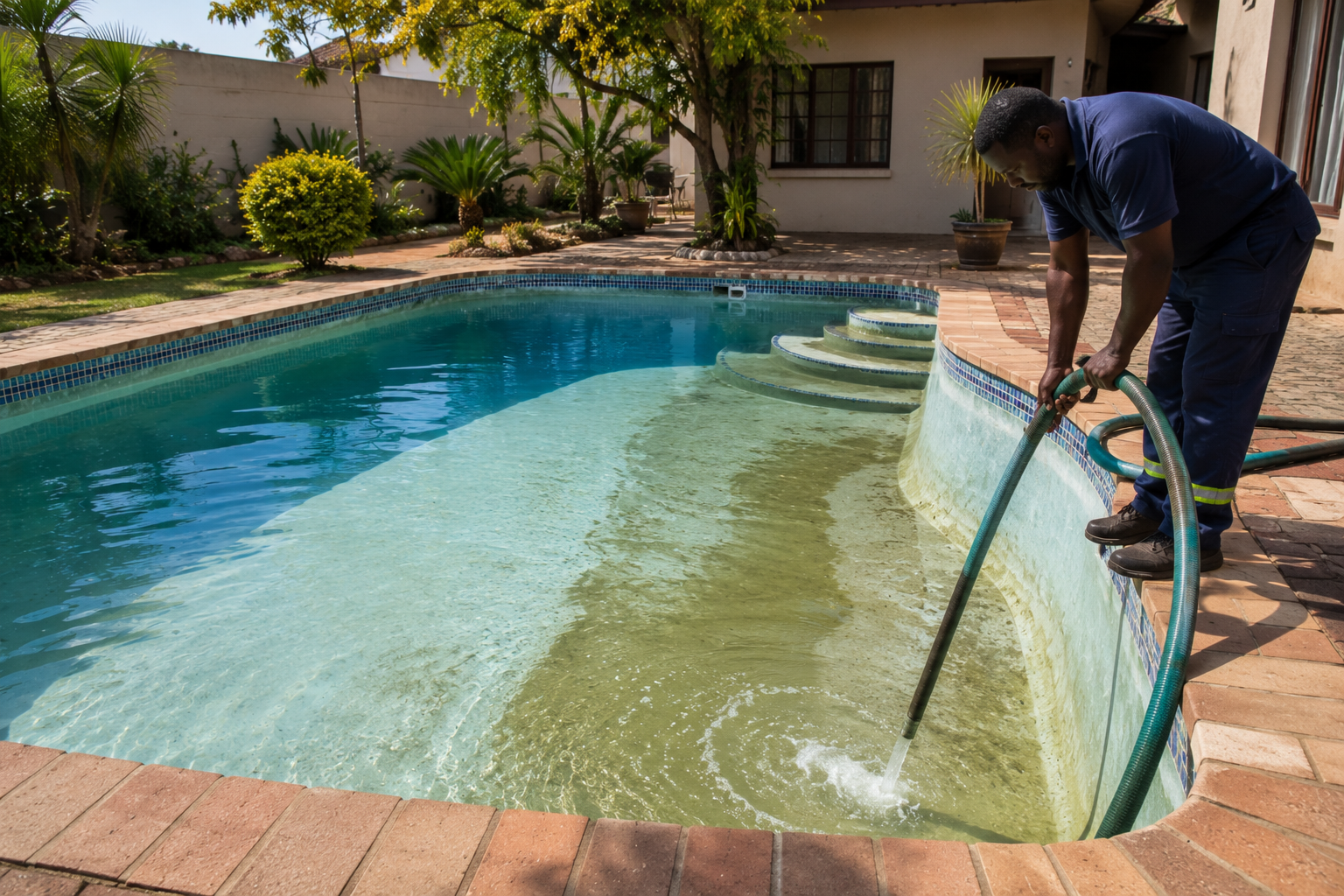
Many swimming pool owners assume that once pool water turns green, cloudy, or difficult to balance, the only solution is to drain everything and start again. In Zimbabwe, this is a very common misconception, especially after heavy rains, algae outbreaks, or long periods of neglected maintenance.
The truth is that most swimming pools should not need complete draining regularly. In fact, a properly maintained pool can keep the same water for several years with only partial replacement along the way. Modern pool systems are designed to clean, circulate, and chemically balance the water continuously rather than constantly replacing it.
Draining a pool unnecessarily can waste large amounts of water, increase chemical costs, and in some cases even damage the pool structure itself. At the same time, there are situations where draining becomes unavoidable because the water quality has deteriorated too severely for normal treatment to work effectively.
Understanding when a full drain is actually necessary helps homeowners avoid expensive mistakes while protecting both the pool and the circulation equipment.
Not Sure Whether Your Pool Needs Draining?
Fill in the form below for expert advice on pool water quality, algae treatment, and swimming pool maintenance solutions.
Why Most Pools Do Not Need Complete Draining
One of the biggest misunderstandings about swimming pools is the idea that the water must regularly be replaced entirely. In reality, pool water is continuously filtered, chemically balanced, and sanitised through the circulation system.
As long as the filtration system is working properly and the chemical balance remains under control, the same pool water can remain usable for years. Small amounts of water are naturally replaced over time through evaporation, splash-out, backwashing, cleaning, and rainfall dilution.
This gradual replacement process is usually enough to maintain healthy water conditions when combined with proper servicing.
Many homeowners become concerned when the pool starts looking slightly cloudy or green after storms or periods of neglect. However, in many cases, these problems can still be corrected without draining the pool completely.
Professional swimming pool maintenance services often restore severely neglected pools through chemical treatment, filtration correction, vacuuming, and circulation improvements rather than full draining.
Why Green Pool Water Does Not Always Mean You Must Drain It
A green swimming pool is one of the main reasons homeowners panic and consider emptying the entire pool.
In most cases, green water is caused by algae growth rather than permanently damaged water. Algae usually develops because chlorine levels dropped too low, circulation became poor, the filter struggled, or the pool was neglected for too long during hot weather.
Zimbabwe’s warm climate makes algae especially aggressive during summer months because sunlight and high temperatures create ideal growing conditions.
Fortunately, many green pools can still recover without full draining. Proper shocking, algae treatment, brushing, vacuuming, and filtration cleaning are often enough to restore water clarity if the problem is addressed early enough.
Some pools may look terrible visually while still being chemically recoverable.
This is why experienced pool professionals usually test the water and inspect the filtration system before recommending a full drain. Draining too quickly often wastes water unnecessarily while increasing the time and cost required to rebalance the pool afterward.
When Draining the Pool Actually Becomes Necessary
Although most pools do not require regular draining, there are situations where a complete or partial water replacement becomes the best option.
One common example is extremely high total dissolved solids, often referred to as TDS. Over time, minerals, chemicals, salts, debris, and contaminants accumulate in the water. Once these dissolved solids become excessive, balancing the water chemistry becomes increasingly difficult no matter how many chemicals are added.
In some Zimbabwean properties, especially those relying heavily on borehole water, mineral content can gradually build up over long periods and eventually create water balance issues that become difficult to manage.
Severe chemical imbalance is another reason draining may become necessary. Pools that were heavily over-treated with chemicals or neglected for very long periods sometimes reach a stage where normal recovery becomes impractical.
Major contamination can also justify draining. Floodwater intrusion, severe organic contamination, or accidental chemical problems may make replacement safer and more cost-effective than attempting recovery.
Structural repairs and renovations are another common reason pools are emptied. Surface repairs, relining work, crack repairs, tile replacement, or major plumbing upgrades often require the pool to be drained before work can begin safely.
Many homeowners only discover underlying structural issues after years of neglecting smaller maintenance problems.
Dealing With Green or Cloudy Pool Water?
Fill in the form below for help with algae treatment, water balancing, filtration problems, and professional pool cleaning solutions.
Why Draining a Pool Can Sometimes Be Risky
Many people assume draining a pool is harmless as long as the water is removed carefully. However, completely empty pools can sometimes experience structural stress, especially if draining is done incorrectly.
Concrete pools, fibreglass pools, and vinyl-lined pools all react differently once the water pressure supporting the structure disappears.
In some situations, groundwater pressure beneath the pool can create serious problems once the internal water weight is removed. This is especially important after heavy rains or in areas with poor drainage conditions.
Fibreglass pools are particularly sensitive because the shell relies partly on surrounding pressure balance for stability. Improper draining can sometimes contribute to movement, shifting, or structural stress.
Older pools may also develop cracking problems if drained for extended periods during very hot weather.
This is one reason professional advice is important before completely emptying a swimming pool. Draining should not simply be treated as a routine cleaning step without considering the condition of the structure itself.
Partial Draining vs Full Draining
In many situations, partial draining is far more effective than emptying the entire pool.
If the water chemistry has become difficult to balance because of high mineral levels or chemical buildup, replacing only part of the water may improve the situation significantly without exposing the structure unnecessarily.
Partial water replacement is often safer, faster, and cheaper than full draining, especially for pools that still have structurally healthy water conditions overall.
Many experienced pool technicians prefer partial replacement first before recommending complete draining because it reduces both risk and water waste.
This approach is especially useful in Zimbabwe where water conservation and borehole management are becoming increasingly important concerns for many homeowners.
Borehole Water vs Municipal Water
The source of the water entering the pool also affects long-term maintenance.
Borehole water commonly contains higher mineral levels, iron content, or hardness depending on the local geology. Over time, this may contribute to staining, scaling, cloudy water, or balancing difficulties if not managed correctly.
Municipal water often behaves differently chemically and may require different balancing approaches after refilling.
Some homeowners assume replacing the water will automatically solve every pool problem, but if the incoming water source itself contains high mineral levels, similar issues may eventually return again unless the treatment approach changes as well.
This is why professional water testing becomes important before major draining decisions are made.
Signs Your Pool Water May Need Professional Attention
Some water problems become obvious quickly, while others develop gradually over time.
Persistent cloudiness, recurring algae outbreaks, strong chemical smells, staining, scaling, or water that becomes impossible to balance even after treatment may all indicate deeper water quality problems.
Pools that consume unusually high amounts of chlorine or constantly drift out of chemical balance may also have excessive dissolved solids or circulation issues affecting overall water quality.
At the same time, many pools that appear severely neglected visually are still recoverable without draining once the filtration and chemical balance are corrected properly.
This is why proper inspection matters before making expensive decisions.
Why Proper Maintenance Reduces the Need for Draining
Consistent maintenance is the biggest reason many pools avoid full draining for years.
Regular cleaning, filtration maintenance, backwashing, chemical balancing, and circulation checks help prevent the gradual buildup of contaminants that eventually create severe water quality problems.
Pools with efficient circulation systems and properly maintained equipment usually remain easier to balance chemically over the long term.
Neglected pools, on the other hand, often experience recurring algae outbreaks, poor filtration performance, and unstable chemistry that eventually push the water beyond practical recovery.
This is one reason many homeowners eventually upgrade filtration systems or circulation equipment during larger pool renovation projects.
Preventative maintenance almost always costs less than recovering severely neglected water conditions later.
Final Thoughts
Most swimming pools in Zimbabwe do not require regular full draining. In many cases, cloudy or green water can still be restored successfully through proper chemical treatment, circulation correction, filtration cleaning, and ongoing maintenance.
While there are situations where draining becomes necessary, such as severe contamination, extremely high dissolved solids, or major renovation work, draining should never be treated as the automatic solution to every pool problem.
Unnecessary draining wastes water, increases costs, and may even create structural risks if handled incorrectly.
The best approach is always proper diagnosis first. Understanding the condition of the water, the filtration system, and the pool structure helps determine whether the problem can be corrected through treatment or whether more extensive water replacement is genuinely required.
Not Sure If Your Pool Needs Draining?
Fill in the form below for expert advice on pool water problems, algae treatment, and professional swimming pool maintenance solutions.


Comments are closed